Steun dit dossier

Steun dit dossier

Het Palestina op de kaart dossier bestaat — zonder betaalmuren — mede dankzij betalende lezers. Help je mee? Steun dit dossier met een eenmalige donatie.
Doneer 1× aan dit dossier

Word daarnaast lid van Momus (vanaf €3 per maand) om al ons werk te steunen.


Ontvang updates over dit dossier in je inbox

Via onze Palestina op de Kaart nieuwsbrief blijf je op de hoogte én kun je meedenken over dit onderzoek op basis van vragen die we via deze nieuwsbrief delen.

Ontvang je al één of meer van onze nieuwsbrieven? Verander je voorkeuren via de knop in de Momus-nieuwsbrieven die je al ontvangt en vink de Palestina op de kaart nieuwsbrief aan.

Ontvang je nog geen enkele nieuwsbrief van Momus? Schrijf je hier in en vink de Palestina op de kaart nieuwsbrief aan.


Tips en ideeën voor dit dossier

Heb jij tips of ideeën voor dit dossier? Laat het ons weten.

Naar het tipformulier


Naast het steunen en volgen van dit zorgdossier kun je ook Momus zelf steunen als lid vanaf 3 euro per maand, of via een eenmalige donatie naar keuze. Je blijft op de hoogte en denkt mee over al ons werk via onze nieuwsbrieven of social media+Vind ons op Instagram, LinkedIn, Facebook, Youtube en TikTok. Stuur ons algemene tips, ideeën of vragen als tekst via dit formulier, of als audiobericht via onze online open microfoon.

Foto's: Engy Abdelal

This report was written by Engy Abdelal, a journalist from Gaza. In the (mostly Dutch) dossier Palestine on the Map, Momus works directly with Palestinian journalists and researchers to shed light on the present, past and future of Palestine.

In Gaza, the lives of kidney failure patients in the dialysis unit at Al-Shifa Hospital are not measured in years but in how many sessions they manage to survive without power cuts or medicine shortages. Three times a week they are supposed to receive treatment, but many now receive far less than their condition requires in a health system shattered by the genocidal war waged by the Israeli army on the Gaza Strip.

Mustafa al-Liwa, a man in his thirties displaced from eastern Shuja’iyya to al-Nasr neighbourhood in western Gaza, has been living with kidney failure since 2019. He describes life before the war as ‘harsh but organised’: three dialysis sessions a week, each four hours long, with regular blood transfusions and calcium tablets to replace what the machine washed out of his body. ‘Before the war, we used to have dialysis regularly, take stable medication and relatively healthy food. I could walk long distances, do some simple work, and actually feel like I was in my thirties,’ he recalls.

‘Everything has changed,’ he says. Calcium has vanished from pharmacies, and blood transfusions have become so rare that most patients have gone months without a single dose, while the dialysis machine keeps stripping minerals from their blood with no replacement. Under a suffocating blockade, canned food has replaced fresh produce. ‘Canned food is our most dangerous enemy,’ Mustafa adds, ‘but we had no other choice. We were eating what we knew was harmful to our kidneys so we wouldn’t die of hunger before we died of the disease.’

Dialysis sessions themselves have been cut back. Instead of three regular weekly sessions, many patients now receive only one or two, often lasting no more than two hours, because of fuel shortages and the lack of supplies needed to run the machines and water-treatment units. ‘We hardly ever get a full session anymore,’ Mustafa explains. ‘We leave feeling nauseous, with swollen limbs and constant shortness of breath,’ he says. ‘I reach the hospital exhausted before dialysis even starts, and leave even more exhausted, knowing I’ll make the same trip a day or two later. At thirty, I feel like my bones are much older than my age,’ he adds.

Mustafa’s story is not unique. Laila Jundiyeh, a woman in her sixties displaced from Shuja’iyya to al-Amal Institute for Orphans in central Gaza City, says she barely knew the dialysis unit before the war. Pointing to a body worn down by displacement, she explains simply: ‘It’s the war that damaged my kidneys.’ Months of hunger, an almost total dependence on canned food, severe shortages of clean water and relentless psychological stress all combined, she says, to push her into kidney failure.

We were eating what we knew was harmful to our kidneys so we wouldn’t die of hunger before we died of the disease.

For sixty-four-year-old Sabah Yassin, the war has redrawn time itself according to dialysis schedules. ‘As soon as I return from dialysis to where we’re displaced, I collapse in bed for two days,’ she says. ‘I can’t manage even the simplest household tasks,’ she adds. She began dialysis a year before the war, but when Israeli forces stormed Al-Shifa and sessions were halted for more than a week, she says she ‘came close to death in a very real way’.

After that, Sabah had to go once to the Indonesian Hospital in the north, then flee to Deir al-Balah Hospital in the central Strip after Gaza City was turned into an open military zone. Reaching a dialysis machine became an added gamble atop the illness itself. Today, she undergoes dialysis every other day, but hers is no longer the only body connected to tubes. During the war, her husband also developed kidney failure after months of severe psychological pressure. ‘Now my husband and I both have dialysis in the same ward,’ she notes. ‘One disease stretched by one war across two bodies in the same family,’ she says.

Sabah says she now knows the language of numbers in her blood. Before the war, her haemoglobin level – which carries oxygen – reached 11 with regular blood transfusions. Now it barely reaches 6, amid acute shortages of blood transfusions, iron and calcium. She tries to avoid canned food, relying instead on what little Gazan dukkah and low-salt foods she can find, but admits that most of the food entering the Strip today is frozen or processed – entirely unsuitable, she explains, for a fragile body that needs fresh, low-additive nutrition.
What is kidney failure and what happens without adequate treatment?+This is an editorial note

Internist-nephrologist Nouaf Ajubi offers a crash course. Treating kidney patients is a ʻtrinity,’ Ajubi explains: dialysis, medication and a proper diet. ʻIf one part falls away, the whole house of cards collapses.’ Blood transfusions used as an alternative to medication — now increasingly common in Gaza because of medicine shortages imposed by Israel, according to the World Health Organization — are also not without risks, Ajubi explains.

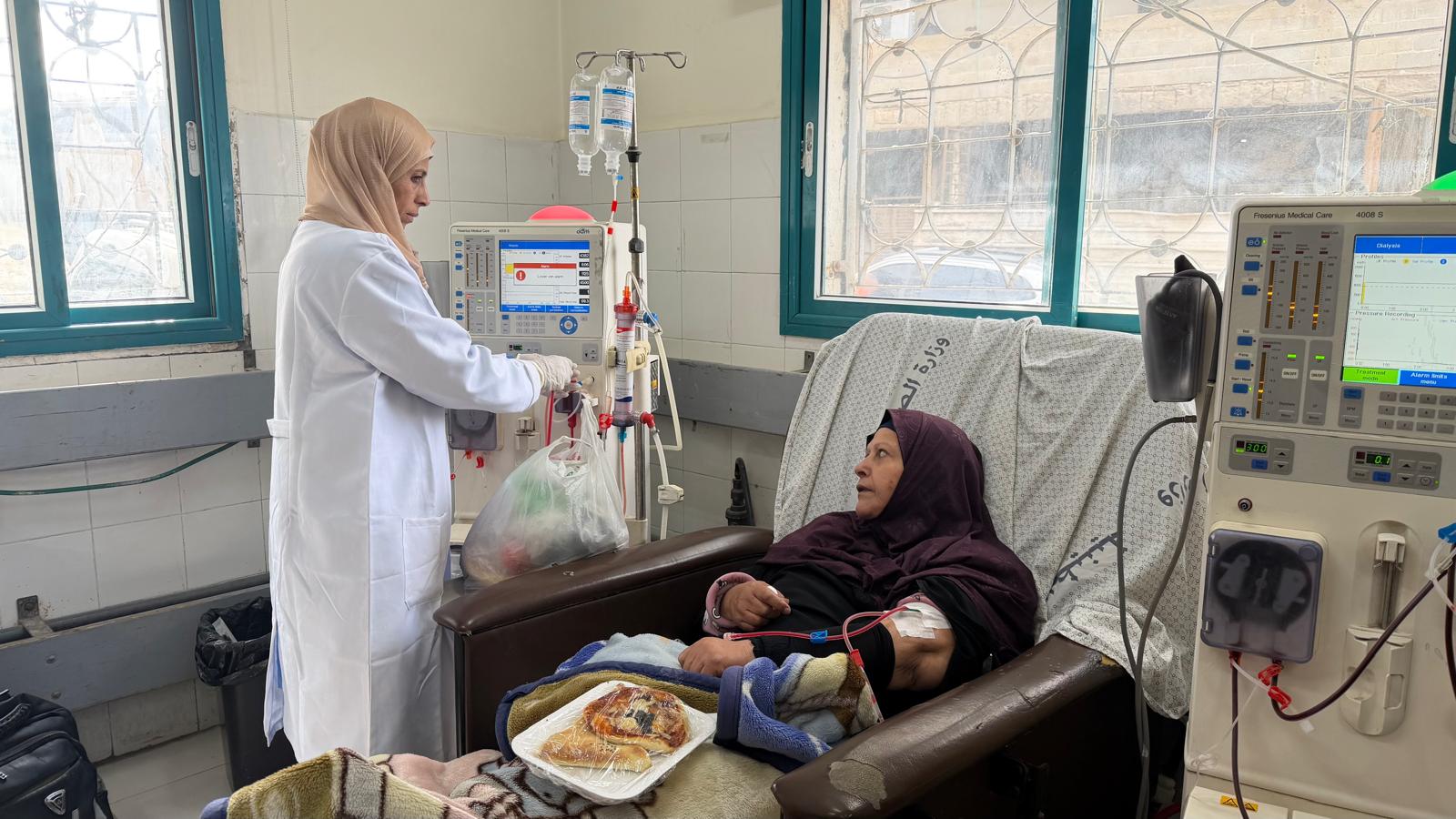
On the other side of the bed, nurse Nihad Darwish, who has worked in Al-Shifa’s dialysis unit for more than ten years, describes trying to practise her profession inside what she calls ‘a healthcare system with amputated resources’. She points out that the unit faces severe shortages of essential medications for kidney-failure patients, including Recormon, which boosts haemoglobin and reduces the need for blood transfusions but has become almost unavailable. As a result, she says, staff are forced to rely on blood units, with all the added risks for patients and overstretched blood banks.+In his explanation of kidney failure (see box above), nephrologist Nouaf Ajubi also discusses the risks of using blood transfusions as an alternative to medication for kidney patients, including the risk of infections and the reduced chances of a successful kidney transplant in the future (Ed.).

The Al-Shifa hospital before and after the attacks by the Israeli army. Pictures: Jaber Jehad Badwan, October 11, 2023 (CC BY-SA 4.0) and April 15, 2025 (CC BY-SA 4.0)

Beyond drugs, Nihad explains, she and her colleagues face shortages of calcium and iron supplements, and of basic supplies such as dressings, needles, filters and tubing. The hospital is also trapped in a cycle of fuel, electricity and water crises that have repeatedly forced staff to shorten dialysis sessions or cancel them altogether. ‘We monitor the electricity meter like we monitor the patients’ vital signs,’ she says. ‘Sometimes we complete the session hoping the power will stay on; sometimes we’re forced to stop it abruptly,’ she adds. When the water-treatment plant stops, dialysis is halted and postponed, meaning fluid builds up in patients’ bodies, increasing pressure on their hearts and lungs and turning shortness of breath into an emergency in moments.

Blood transfusions available in every session, calcium and iron tablets that are not treated as rare commodities, dialysis machines that can run for their full prescribed hours without fear of sudden power cuts, regularly filtered water, and safe, affordable transport from shelters to the hospital door – none of this, health workers stress, is a luxury. It is the bare minimum of the right to treatment.

Until these basics are guaranteed, one question will remain hanging over the rows of dialysis beds in Al-Shifa and across Gaza: how many more patients must edge closer to death – or fall over its brink – before the world sees Gaza’s kidney-failure patients as full human beings who deserve to live, and not just numbers recorded in health-agency reports and mortality statistics, left to languish in the cold memory of the archive?

Numbers

  • In Gaza, according to the World Health Organization, 1,100 kidney patients depend on dialysis treatment to stay alive.
  • A large number of kidney patients were killed as a result of Israeli violence and medicine shortages after October 7, nephrologist Abdullah Wajih Kishawi from Gaza wrote in February 2025: an estimated 44% of kidney patients, according to his calculations.
  • Gaza also lost half of the only six nephrologists (doctors who treat kidney disease) working there before October 7, Kishawi wrote: one of the six nephrologists was killed in Israeli bombardments, while two ended up outside Gaza. Only three nephrologists remained in Gaza.
  • According to the World Health Organization, there are still severe shortages of medicines needed by kidney patients, such as erythropoietin. In one hospital visited, around 80% of kidney patients were receiving blood transfusions instead of the proper medication, despite the risks involved. +See nephrologist Nouaf Ajubi’s explanation above on this issue.